Charlie Munger: The Psychology of Human Misjudgment
Charlie Munger: The Psychology of Human Misjudgment
Talk 11 of the eleven in Chapter Four of Poor Charlie’s Almanack. See The Eleven Talks of Poor Charlie’s Almanack for the full collection.
Key Takeaways
How do you train yourself to be more open to changing your mind?
- This continues to be a really critical theme across Charlie Munger’s thinking: Self-Criticism
Summary of Tendencies
A useful index of Munger’s tendencies: novelinvestor.com — Charlie Munger’s Tendencies of Human Misjudgment
Highlights & Notes
Kyle’s reading layer from Poor Charlie’s Almanack, preserved verbatim. Munger’s text and pulled-in source quotes appear as bullets; Kyle’s own annotations appear as Kyle: callouts.
- Not only would there be stylistic and substantive objections, but also there would be perceptions of arrogance in an old man who displayed much disregard for conventional wisdom while “popping-off” on a subject in which he had never taken a course. My old Harvard Law classmate, Ed Rothschild, always called such a popping-off “the shoe button complex,” named for the condition of a family friend who spoke in oracular style on all subjects after becoming dominant in the shoe button business.
Kyle: Learning in Public; when is it okay to speak declaratively on topics in which you’re not an expert?
- Diogenes when he asked: “Of what use is a philosopher who never offends anybody?”
Kyle: If you’re not offending somebody then you’re not thinking radically enough.
- My third and final reason is the strongest. I have fallen in love with my way of laying out psychology because it has been so useful for me. And so, before I die, I want to imitate to some extent the bequest practices of three characters: the protagonist in John Bunyan’s Pilgrim’s Progress, Benjamin Franklin, and my first employer, Ernest Buffett. Bunyan’s character, the knight wonderfully named “Old Valiant for Truth,” makes the only practical bequest available to him when he says at the end of his life: “My sword I leave to him who can wear it.” And like this man, I don’t mind if I have misappraised my sword, provided I have tried to see it correctly, or that many will not wish to try it, or that some who try to wield it may find it serves them not. Ben Franklin, to my great benefit, left behind his autobiography, his Almanacks, and much else. And Ernest Buffett did the best he could in the same mode when he left behind “How to Run a Grocery Store and a Few Things I Have Learned about Fishing.” Whether or not this last contribution to the genre was the best, I will not say. But I will report that I have now known four generations of Ernest Buffett’s descendants and that the results have encouraged my imitation of the founder. #Don’t Die With Your Music Still in You
- I was soon surrounded by much extreme irrationality, displayed in patterns and in subpatterns. So surrounded, I could see that I was not going to cope as well as I wished with life unless I could acquire a better theory-structure on which to hang my observations and experiences. #Mental Models
- Better theory, I thought, had always worked for me and, if now available, could make me acquire capital and independence faster and better assist everything I loved. And so I slowly developed my own system of psychology, more or less in the self-help style of Benjamin Franklin and with the determination displayed in the refrain of the nursery story: “Then I’ll do it myself,’ said the little red hen.”
Kyle: Get yourself some theories and live by them until they prove to be untrue. Then move onto something better.
- First, I had long looked for insight by inversion in the intense manner counseled by the great algebraist, Jacobi: “Invert, always invert.” I sought good judgment mostly by collecting instances of bad judgment, then pondering ways to avoid such outcomes. Second, I became so avid a collector of instances of bad judgment that I paid no attention to boundaries between professional territories. After all, why should I search for some tiny, unimportant, hard-to-find new stupidity in my own field when some large, important, easy-to-find stupidity was just over the fence in the other fellow’s professional territory? #Inversion #Multidisciplinary Thinking
- “When performance is measured, performance improves. When performance is measured and reported, the rate of improvement accelerates” Thomas S. Monson
- I may have been lucky to avoid for so long the academic psychology that was then laid out in most textbooks. #Academia
- And I found that introductory psychology texts, by and large, didn’t deal appropriately with a fundamental issue: Psychological tendencies tend to be both numerous and inseparably intertwined, now and forever, as they interplay in life. Yet the complex parsing out of effects from intertwined tendencies was usually avoided by the writers of the elementary texts. Possibly the authors did not wish, through complexity, to repel entry of new devotees to their discipline. And, possibly, the cause of their inadequacy was the one given by Samuel Johnson in response to a woman who inquired as to what accounted for his dictionary’s misdefinition of the word “pastern.” “Pure ignorance,” Johnson replied. And, finally, the text writers showed little interest in describing standard antidotes to standard psychology-driven folly, and they thus avoided most discussion of exactly what most interested me.
Kyle: The impracticality of Academia; There is a spectrum here between over-complex academia and worthless “pop” psychology
- With the push given by Cialdini’s book, I soon skimmed through three much used textbooks covering introductory psychology. I also pondered considerably while craving synthesis and taking into account all my previous training and experience. The result was Munger’s partial summary of the non-patient-treating, non-nature vs. nurture weighing parts of nondevelopmental psychology. This material was stolen from its various discoverers (most of whose names I did not even try to learn), often with new descriptions and titles selected to fit Munger’s notion of what makes recall easy for Munger, then revised to make Munger’s use easy as he seeks to avoid errors. #Honesty #Progressive Summarization
- Man’s-often wrong but generally useful psychological tendencies are quite numerous and quite different. The natural consequence of this profusion of tendencies is the grand general principle of social psychology: cognition is ordinarily situation-dependent so that different situations often cause different conclusions, even when the same person is thinking in the same general subject area.
- Federal Express case: it was foolish to pay the night shift by the hour when what the employer wanted was not maximized billable hours of employee service but fault free, rapid performance of a particular task. #The Cobra Effect
- Xerox Case: he found out that the commission arrangement with the salesmen gave a large and perverse incentive to push the inferior machine on customers, who deserved a better result. #Incentives
- Consider the presentations of brokers selling commercial real estate and businesses. I’ve never seen one that I thought was even within hailing distance of objective truth. In my long life, I have never seen a management consultant’s report that didn’t end with the same advice: “This problem needs more management consulting services.” #Consulting
- In the end, I concluded that when something was obvious in life but not easily demonstrable in certain kinds of easy-to-do, repeatable academic experiments, the truffle hounds of psychology very often missed it.
- The inevitable ubiquity of incentive-caused bias has vast, generalized consequences. For instance, a sales force living only on commissions will be much harder to keep moral than one under less pressure from the compensation arrangement. On the other hand, a purely commissioned sales force may well be more efficient per dollar spent. Therefore, difficult decisions involving trade-offs are common in creating compensation arrangements in the sales function. #Incentives
- Another generalized consequence of incentive caused bias is that man tends to “game” all human systems, often displaying great ingenuity in wrongly serving himself at the expense of others. Anti-gaming features, therefore, constitute a huge and necessary part of almost all system design. Also needed in system design is an admonition: Dread, and avoid as much you can, rewarding people for what can be easily faked. Yet our legislators and judges, usually including many lawyers educated in eminent universities, often ignore this injunction. And society consequently pays a huge price in the deterioration of behavior and efficiency, as well as the incurrence of unfair costs and wealth transfers. If Education were improved, with psychological reality becoming better taught and assimilated, better system design might well come out of our legislatures and courts. #Systems Thinking #Incentives
- Granny’s Rule, to be specific, is the requirement that children eat their carrots before they get dessert. And the business version requires that executives force themselves daily to first do their unpleasant and necessary tasks before rewarding themselves by proceeding to their pleasant tasks. Given reward superpower, this practice is wise and sound. Moreover, the rule can also be used in the nonbusiness part of life. The emphasis on daily use of this practice is not accidental. The consultants well know, after the teaching of Skinner, that prompt rewards work best.
Kyle: Behavioral establishments that limit your dependence on your stupid brain #Behavioral Economics
- One very practical consequence of Liking/Loving Tendency is that it acts as a conditioning device that makes the liker or lover tend (1) to ignore faults of, and comply with wishes of, the object of his affection, (2) to favor people, products, and actions merely associated with the object of his affection (as we shall see when we get to “Influence-from-Mere-Association Tendency,” and (3) to distort other facts to facilitate love.
Kyle: Working up to “love blindness.”
- Liking or loving, intertwined with admiration in a feedback mode, often has vast practical consequences in areas far removed from sexual attachments. For instance, a man who is so constructed that he loves admirable persons and ideas with a special intensity has a huge advantage in life. This blessing came to both Warren Buffett and myself in large measure, sometimes from the same persons and ideas.
Kyle: You should have strong opinions about the people and ideas that you work with.
- Disliking/Hating Tendency also acts as a conditioning device that makes the disliker/hater tend to (1) ignore virtues in the object of dislike, (2) dislike people, products, and actions merely associated with the object of his dislike, and (3) distort other facts to facilitate hatred.
- After all, the one thing that is surely counterproductive for a prey animal that is threatened by a predator is to take a long time in deciding what to do. And so man’s Doubt-Avoidance Tendency is quite consistent with the history of his ancient, nonhuman ancestors.
Kyle: Allow yourself to wrestle with uncomfortable realities
- “Growing deep roots requires that we learn to work through uncomfortable realities.” Faith Is Not Blind
- So pronounced is the tendency in man to quickly remove doubt by reaching some decision that behavior to counter the tendency is required from judges and jurors.
Kyle: Reminds me of Doubt (movie); SISTER ALOYSIUS: I have doubts! I have such doubts!
- When Marley’s miserable ghost says, “I wear the chains I forged in life,” he is talking about chains of Habits that were too light to be felt before they became too strong to be broken.
- 2 Nephi 28:21-22
- 21 And others will he pacify, and lull them away into carnal security, that they will say: All is well in Zion; yea, Zion prospereth, all is well. and thus the devil cheateth their souls, and leadeth them away carefully down to hell.
- 22 And behold, others he flattereth away, and telleth them there is no hell; and he saith unto them: I am no devil, for there is none. and thus he whispereth in their ears, until he grasps them with his awful chains, from whence there is no deliverance.
- 2 Nephi 28:21-22
- Also tending to be maintained in place by the anti change tendency of the brain are one’s previous conclusions, human loyalties, reputational identity, commitments, accepted role in a civilization, etc. It is not entirely clear why evolution would program into man’s brain an anti-change mode alongside his tendency to quickly remove doubt.
- “The test of a first-rate intelligence is the ability to hold two opposed ideas in mind at the same time and still retain the ability to function.” F. Scott Fitzgerald
- “It ain’t what you don’t know that gets you into trouble. It’s what you know for sure that just ain’t so.” Mark Twain
- And so, people tend to accumulate large mental holdings of fixed conclusions and attitudes that are not often reexamined or changed, even though there is plenty of good evidence that they are wrong.
- Permanent Assumptions by Morgan Housel
- Max Planck is famous not only for his science but also for saying that even in physics the radically new ideas are seldom really accepted by the old guard. Instead, said Planck, the progress is made by a new generation that comes along, less brain blocked by its previous conclusions. Indeed, precisely this sort of brain blocking happened to a degree in Albert Einstein. At his peak, Einstein was a great destroyer of his own ideas, but an older Einstein never accepted the full implications of quantum mechanics.
Kyle: How do you train yourself to be more open to changing your mind?
- Keynes said, “It’s not bringing in the new ideas that’s so hard. It’s getting rid of the old ones.” And Einstein said it better, attributing his mental success to “curiosity, concentration, perseverance, and self-criticism.” By self-criticism, he meant becoming good at destroying your own best-loved and hardest-won ideas. If you can get really good at destroying your own wrong ideas, that is a great gift. #Self-Criticism
- Walton was known for his fierce competitiveness. He didn’t care about being right; he cared about winning retail. Walton was so obsessed with retailing that he wasn’t worried about destroying his old beliefs if he found new evidence that contradicted it. #Self-Criticism
- I have what I call an “iron prescription” that helps me keep sane when I drift toward preferring one intense ideology over another. I feel that I’m not entitled to have an opinion unless I can state the arguments against my position better than the people who are in opposition. I think that I am qualified to speak only when I’ve reached that state. Charlie Munger #Self-Criticism
- One of the most successful users of an antidote to first conclusion bias was Charles Darwin. He trained himself, early, to intensively consider any evidence tending to disconfirm any hypothesis of his, more so if he thought his hypothesis was a particularly good one. The opposite of what Darwin did is now called Confirmation Bias, a term of opprobrium. Darwin’s practice came from his acute recognition of man’s natural cognitive faults arising from Inconsistency-Avoidance Tendency.
- I have what I call an “iron prescription” that helps me keep sane when I drift toward preferring one intense ideology over another. I feel that I’m not entitled to have an opinion unless I can state the arguments against my position better than the people who are in opposition. I think that I am qualified to speak only when I’ve reached that state. Charlie Munger #Self-Criticism
- For instance, modern Education often does much damage when young students are taught dubious political notions and then enthusiastically push these notions on the rest of us. The pushing seldom convinces others. But as students pound into their mental habits what they are pushing out, the students are often permanently damaged. Educational institutions that create a climate where much of this goes on are, I think, irresponsible. It is important not to thus put one’s brain in chains before one has come anywhere near his full potentiality as a rational person.
Kyle: Be taught to question your notions in a healthy way.
- “It ain’t what you don’t know that gets you into trouble. It’s what you know for sure that just ain’t so.” Mark Twain
- In advanced human civilization, culture greatly increases the effectiveness of curiosity in advancing knowledge. For instance, Athens (including its colony, Alexandria) developed much math and science out of pure curiosity while the Romans made almost no contribution to either math or science. They instead concentrated their attention on the “practical” engineering of mines, roads, aqueducts, etc. Curiosity, enhanced by the best of modern education (which is by definition a minority part in many places), much helps man to prevent or reduce bad consequences arising from other psychological tendencies. The curious are also provided with much fun and wisdom long after formal education has ended.
Kyle: Rome vs. Athens. We seem much more like Rome than Athens today (e.g. focused on the practical.)
- Part of the problem is clearly foresight, a failure of imagination. But the other part of the problem is what we didn’t do in advance, and what we’re failing to do now. And that is a failure of action, and specifically our widespread inability to build. Marc Andreessen
- “Too many smart people go into finance and law. That’s both a compliment and a criticism.” Elon Musk
- It is interesting how the world’s slavery was pretty well abolished during the last three centuries after being tolerated for a great many previous centuries during which it coexisted with the world’s major religions. My guess is that Kantian Fairness Tendency was a major contributor to this result. #Veil of Ignorance
Kyle: While the fairness tendency doesn’t actually seem to push for more fairness it made me think of three things:
- The Veil of Ignorance: Designing a world where we don’t know what we’ll end up as will encourage you to make it as fair as possible.
- Having Empathy for everyone: On why he’s a vegetarian: “I can’t imagine eating anything that had a mother.” Fred Rogers
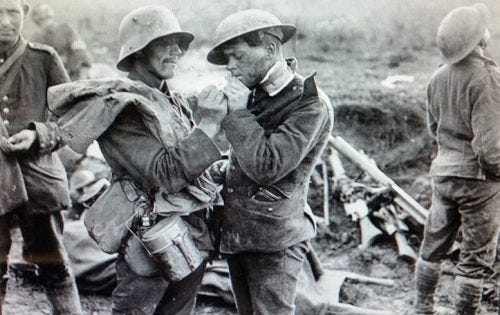
- Acknowledging Humanity: Everyone is a person even when you’re shooting at them #1914 Christmas Truce
- Many big law firms, fearing disorder from envy/jealousy, have long treated all senior partners alike in compensation, no matter how different their contributions to firm welfare. As I have shared the observation of life with Warren Buffett over decades, I have heard him wisely say on several occasions: “It is not greed that drives the world, but envy.”
Kyle: Interesting to think about productivity and compensation among sales reps vs. call center workers. (E.g. “they never want to work.”)
- The standard antidote to one’s overactive hostility is to train oneself to defer reaction. As my smart friend Tom Murphy so frequently says, “You can always tell the man off tomorrow, if it is such a good idea.” #Self-control
- “One day he handed written instructions to a switchman who, upon reading the directions, flew into a tantrum. The scene that followed disgusted Gordon: ‘He was a fifty-year old man but he acted like a spoiled child. He threw his cap on the ground and jumped on it and let forth such a string of expletives as to seem to cause the air to turn blue around him. Every third or fourth word was the name of Deity spoken in vain. I thought, how childish can a grown man be? The very idea of a man acting and speaking like that was totally repugnant. I could never again give him my full respect.’” #Reputation #Self-control Gordon B. Hinckley
- Of course, the tendency to reciprocate favor for favor is also very intense, so much so that it occasionally reverses the course of reciprocated hostility. Weird pauses in fighting have sometimes occurred right in the middle of wars, triggered by some minor courtesy or favor on the part of one side, followed by favor reciprocation from the other side, and so on, until fighting stopped for a considerable period. This happened more than once in the trench warfare of World War I, over big stretches of the front and much to the dismay of the generals.
- 1914 Christmas Truce
- 1914 Christmas Truce
- In a famous psychology experiment, Cialdini brilliantly demonstrated the power of “compliance practitioners” to mislead people by triggering their subconscious Reciprocation Tendency. Carrying out this experiment, Cialdini caused his “compliance practitioners” to wander around his campus and ask strangers to supervise a bunch of juvenile delinquents on a trip to a zoo. Because this happened on a campus, one person in six out of a large sample actually agreed to do this. After accumulating this one-in-six statistic, Cialdini changed his procedure. His practitioners next wandered around the campus asking strangers to devote a big chunk of time every week for two years to the supervision of juvenile delinquents. This ridiculous request got him a one hundred percent rejection rate. But the practitioner had a follow-up question: “Will you at least spend one afternoon taking juvenile delinquents to a zoo?” This raised Cialdini’s former acceptance rate of 1/6 to 1/2-a tripling. What Cialdini’s “compliance practitioners” had done was make a small concession, which was reciprocated by a small concession from the other side. This subconscious reciprocation of a concession by Cialdini’s experimental subjects actually caused a much increased percentage of them to end up irrationally agreeing to go to a zoo with juvenile delinquents. Now, a professor who can invent an experiment like that, which so powerfully demonstrates something so important, deserves much recognition in the wider world, which he indeed got to the credit of many universities that learned a great deal from Cialdini.
- There is a charming Irish Catholic priest in my neighborhood who, with rough accuracy, often says, “The old Jews may have invented guilt, but we Catholics perfected it.” And if you, like me and this priest, believe that, averaged out, feelings of guilt do more good than harm, you may join in my special gratitude for reciprocate-favor tendency, no matter how unpleasant you find feelings of guilt. #Guilt vs. Shame
- But there is another type of conditioned reflex wherein mere association triggers a response. For instance, consider the case of many men who have been trained by their previous experience in life to believe that when several similar items are presented for purchase, the one with the highest price will have the highest quality. Knowing this, some seller of an ordinary industrial product will often change his product’s trade dress and raise its price significantly hoping that quality-seeking buyers will be tricked into becoming purchasers by mere association of his product and its high price. This industrial practice frequently is effective in driving up sales and even more so in driving up profits. For instance, it worked wonderfully with high-priced power tools for a long time. And it would work better yet with high-priced pumps at the bottom of oil wells. With luxury goods, the process works with a special boost because buyers who pay high prices often gain extra status from thus demonstrating both their good taste and their ability to pay. #Black & Decker vs. DeWalt Case Study
- Advertisers know about the power of mere association. You won’t see Coke advertised alongside some account of the death of a child. Instead, Coke ads picture life as happier than reality. #Marketing
- To avoid being misled by the mere association of some fact with past success, use this memory clue. Think of Napoleon and Hitler when they invaded Russia after using their armies with much success elsewhere.
- The proper antidotes to being made such a patsy by past success are (1) to carefully examine each past success, looking for accidental, noncausative factors associated with such success that will tend to mislead as one appraises odds implicit in a proposed new undertaking and (2) to look for dangerous aspects of the new undertaking that were not present when past success occurred. #Self-Reflection
- People disagree about how much blindness should accompany the association called love. In Poor Richard’s Almanack Benjamin Franklin counseled: “Keep your eyes wide open before marriage, and half shut thereafter.” Perhaps this “eyes-half-shut” solution is about right, but I favor a tougher prescription: “See it like it is and love anyway.”
- “Keep your eyes wide open before marriage, and half shut afterwards.” (Poor Richard’s Almanac) #Marriage
- Choose a companion carefully and prayerfully; and when you are married, be fiercely loyal one to another. Priceless advice comes from a small framed plaque I once saw in the home of an uncle and aunt. It read, “Choose your love; love your choice.” There is great wisdom in those few words. Commitment in marriage is absolutely essential. Thomas S. Monson
- CBS, in its late heyday, was famous for occurrence of Persian Messenger Syndrome because Chairman Paley was hostile to people who brought him bad news. The result was that Paley lived in a cocoon of unreality, from which he made one bad deal after another, even exchanging a large share of CBS for a company that had to be liquidated shortly thereafter. The proper antidote to creating Persian Messenger Syndrome and its bad effects, like those at CBS, is to develop, through exercise of will, a habit of welcoming bad news. At Berkshire, there is a common injunction: “Always tell us the bad news promptly. It is only the good news that can wait. It also helps to be so wise and informed that people fear not telling you bad news because you are so likely to get it elsewhere. #Spirit of Humility
Kyle: In Ford vs. Ferrari, right after acknowledging that Ford could go under, the board then immediately reacts negatively to Lee Iacocca asking, “Why should Mr. Ford listen to you? And he says, “We’ve been thinking wrong.”
Kyle: Learning like Sam Walton:
- “When Sam Walton meets you, he looks at you—head cocked to one side, forehead slightly creased—and he proceeds to extract every piece of information in your possession. He always makes little notes. And he pushes on and on. After two and a half hours, he left, and I was totally drained. I wasn’t sure what I had just met, but I was sure we would hear more from him.”
- “It was a real blessing for me to be so green and ignorant, because it was from that experience that I learned a lesson which has stuck with me through all the years: you can learn from everybody. I didn’t just learn from reading every retail publication I could get my сan hands on, on, I probably learned the most from studying what [my competitor] was doing across the street.” Sam Walton #Spirit of Humility
- Instead, just as he must learn that trend does not always correctly predict destiny, he must learn that the average dimension in some group will not reliably guide him to the dimension of some specific item. Otherwise Pete will make many errors, like that of the fellow who drowned in a river that averaged out only eighteen inches deep. #Forecasting
Kyle: People who anchor their expectations to averages will never fully understand outliers.
- This phenomenon first hit me hard in World War II when the superathlete, superstudent son of a family friend flew off over the Atlantic Ocean and never came back. His mother, who was a very sane woman, then refused to believe he was dead. That’s Simple, Pain-Avoiding Psychological Denial. The reality is too painful to bear, so one distorts the facts until they become bearable. We all do that to some extent, often causing terrible problems. The tendency’s most extreme outcomes are usually mixed up with love, death, and chemical dependency.
Kyle: What do you use to dull the pain?
- We all commonly observe the excessive self regard of man. He mostly misappraises himself on the high side, like the ninety percent of Swedish drivers that judge themselves to be above average. Such misappraisals also apply to a person’s major “possessions.” One spouse usually over-appraises the other spouse. And a man’s children are likewise appraised higher by him than they are likely to be in a more objective view. Even man’s minor possessions tend to be overappraised. Once owned, they suddenly become worth more to him than he would pay if they were offered for sale to him and he didn’t already own them. There is a name in psychology for this overappraise-your-own-possessions phenomenon: the “endowment effect.” And all man’s decisions are suddenly regarded by him as better than would have been the case just before he made them.
- You can’t overappraise yourself but instead should acknowledge your limitations and adjust accordingly: “Bryant believed that one should expect the best in others, that there was decency and goodness in the common man and nobility in the working class. He explained to his posterity on one occasion: ‘**There is no royalty like the royalty of high endeavor. We do not belong to a family of geniuses. We cannot depend upon our good looks or our native brilliance of mind to carry us forward. Each of us must pay the price of hard work if we achieve. **We belong to the working class — a distinction. Only workers are found among the chosen people. Honesty, industry, and common sense make a good combination.”
- Therefore, some of the most useful members of our civilization are those who are willing to “clean house” when they find a mess under their ambit of control.
- “If we try to play like the Yankees in here then we will lose to the Yankees out there.”
- Because man is likely to be overinfluenced by face-to-face impressions that by definition involve his active participation, a job candidate who is a marvelous “presenter” often causes great danger under modern executive-search practice. In my opinion, Hewlett-Packard faced just such a danger when it interviewed the articulate, dynamic Carly Fiorina in its search for a new CEO. And I believe (1) that Hewlett-Packard made a bad decision when it chose Ms. Fiorina and (2) that this bad decision would not have been made if Hewlett-Packard had taken the methodological precautions it would have taken if it knew more psychology.
Kyle: Reminds me of the story from Blink about orchestra auditions happening behind a curtain and drastically improving outcomes.
- There is a famous passage somewhere in Leo Tolstoy that illuminates the power of Excessive Self-Regard Tendency. According to Tolstoy, the worst criminals don’t appraise themselves as all that bad. They come to believe either (1) that they didn’t commit their crimes or (2) that, considering the pressures and disadvantages of their lives, it is understandable and forgivable that they behaved as they did and became what they became. The second half of the “Tolstoy effect”, where the man makes excuses for his fixable poor performance, instead of providing the fix, is enormously important. Because a majority of mankind will try to get along by making way too many unreasonable excuses for fixable poor performance, it is very important to have personal and institutional antidotes limiting the ravages of such folly. On the personal level a man should try to face the two simple facts: (1) fixable but unfixed bad performance is bad character and tends to create more of itself, causing more damage to the excuse giver with each tolerated instance, and (2) in demanding places, like athletic teams and General Electric, you are almost sure to be discarded in due course if you keep giving excuses instead of behaving as you should. The main institutional antidotes to this part of the “Tolstoy effect” are (1) a fair, meritocratic, demanding culture plus personnel handling methods that build up morale and (2) severance of the worst offenders. Of course, when you can’t sever, as in the case of your own child, you must try to fix the child as best you can. I once heard of a child-teaching method so effective that the child remembered the learning experience over fifty years later. The child later became Dean of the USC School of Music and then related to me what his father said when he saw his child taking candy from the stock of his employer with the excuse that he intended to replace it later. The father said, “Son, it would be better for you to simply take all you want and call yourself a thief every time you do it.” #The Tolstoy Effect #Spirit of Humility #Parenting
Kyle: Reminds me of Crime & Punishment and his belief in his “moral right to kill” #Moral Licensing
- “Raskolnikov’s inner conflict in the opening section of the novel results in a utilitarian-altruistic justification for the proposed crime: why not kill a wretched and “useless” old moneylender to alleviate the human misery? Dostoevsky wants to show that this utilitarian style of reasoning had become widespread and commonplace; it was by no means the solitary invention of Raskolnikov’s tormented and disordered mind. Such radical and utilitarian ideas act to reinforce the innate egoism of Raskolnikov’s character, and help justify his contempt for humanity’s lower qualities and ideals. He even becomes fascinated with the majestic image of a Napoleonic personality who, in the interests of a higher social good, believes that he possesses a moral right to kill. Indeed, his “Napoleon-like” plan impels him toward a well-calculated murder, the ultimate conclusion of his self-deception with utilitarianism.” From Wikipedia
- Of course, some high self-appraisals are correct and serve better than false modesty. Moreover, self-regard in the form of a justified pride in a job well done, or a life well lived, is a large constructive force. Without such justified pride, many more airplanes would crash. “Pride” is another word generally left out of psychology textbooks, and this omission is not a good idea. It is also not a good idea to construe the bible’s parable about the Pharisee and the Publican as condemning all pride. Of all forms of useful pride, perhaps the most desirable is a justified pride in being trustworthy. Moreover, the trustworthy man, even after allowing for the inconveniences of his chosen course, ordinarily has a life that averages out better than he would have if he provided less reliability. #Beware of Pride, #Pride and the Priesthood
- “What a man wishes, that also will he believe.” (Demosthenes)
- The Greek orator was clearly right about an excess of optimism being the normal human condition, even when pain or the threat of pain is absent. Witness happy people buying lottery tickets or believing that credit-furnishing, delivery making grocery stores were going to displace a great many superefficient cash-and-carry supermarkets.
- In displaying Deprival-Superreaction Tendency, man frequently incurs disadvantage by misframing his problems. He will often compare what is near instead of what really matters. For instance, a man with $10 million in his brokerage account will often be extremely irritated by the accidental loss of $100 out of the $300 in his wallet.
Kyle: Loss Aversion: Relative loss or gain. Find the story about saving $10 on a $30 purchase vs a $1000 purchase. Story of buying our car, per month amounts aren’t big but added up they get big
- Humans are much the same as this Munger dog. A man ordinarily reacts with irrational intensity to even a small loss, or threatened loss, of property, love, friendship, dominated territory, opportunity, status, or any other valued thing. As a natural result, bureaucratic infighting over the threatened loss of dominated territory often causes immense damage to an institution as a whole.
Kyle: I wonder why we are not as sensitive to losing things to ourselves? Losing time to waste with activities, losing health to laziness, losing dignity to bad behavior.
- It is almost everywhere the case that extremes of ideology are maintained with great intensity and with great antipathy to non-believers, causing extremes of cognitive dysfunction. This happens, I believe, because two psychological tendencies are usually acting concurrently toward this same sad result: (1) Inconsistency-Avoidance Tendency, plus (2) Deprival-Superreaction Tendency. One antidote to intense, deliberate maintenance of groupthink is an extreme culture of courtesy, kept in place despite ideological differences, like the behavior of the justices now serving on the U.S. Supreme Court. Another antidote is to deliberately bring in able and articulate disbelievers of incumbent groupthink. Successful corrective measures to evil examples of groupthink maintenance have included actions like that of Derek Bok when, as president of Harvard, he started disapproving tenure appointments proposed by ideologues at Harvard Law School.
Kyle: How To Begin Teaching in Preach My Gospel is meant to establish Empathy and understanding
- And, of course, teenagers’ parents usually learn more than they would like about teenagers’ cognitive errors from Social-Proof Tendency. This phenomenon was recently involved in a breakthrough by Judith Rich Harris who demonstrated that superrespect by young people for their peers, rather than for parents or other adults, is ordained to some considerable extent by the genes of the young people. This makes it wise for parents to rely more on manipulating the quality of the peers than on exhortations to their own offspring. A person like Ms. Harris, who can provide an insight of this quality and utility, backed by new reasons, has not lived in vain. #Parenting
- If only one lesson is to be chosen from a package of lessons involving Social-Proof Tendency, and used in self improvement, my favorite would be: Learn how to ignore the examples from others when they are wrong, because few skills are more worth having.
Kyle: Live the Library, but not blindly
- “I want no man to lean upon me nor to follow me, only so far as I am a consistent follower in the footsteps of the Master.” Joseph F. Smith
- Few psychological tendencies do more damage to correct thinking. Small-scale damages involve instances such as man’s buying an overpriced $1,000 leather dashboard merely because the price is so low compared to his concurrent purchase of a $65,000 car. Large- scale damages often ruin lives, as when a wonderful woman having terrible parents marries a man who would be judged satisfactory only in comparison to her parents. Or as when a man takes wife number two who would be appraised as all right only in comparison to wife number one.
Kyle: When we did diligence on Fivetran we framed a lot of our questions in terms of “how does this compare to Snowflake ($SNOW)?” And that was the wrong questions because they’re so different that it can make you think FIvetran is bad just because its not as important as Snowflake
- One of Benjamin Franklin’s best-remembered and most useful aphorisms is “A small leak will sink a great ship.” The utility of the aphorism is large precisely because the brain so often misses the functional equivalent of a small leak in a great ship.
Kyle: Sweat the small things.
- In a phenomenon less well recognized but still widely known, light stress can slightly improve performance-say, in examinations whereas heavy stress causes dysfunction.
- This was only possible because of one lesson he learned in astronaut training: Prepare for the worst. “While play-acting grim scenarios day in and day out may sound like a good recipe for clinical depression, it’s actually weirdly uplifting,” Hadfield says.
- “Prepare for the worst, and expect the best to come from it.” - Lori Harrison
- “Anticipating problems and figuring out how to solve them is actually the opposite of worrying: it’s productive.” Chris Hadfield
- This was only possible because of one lesson he learned in astronaut training: Prepare for the worst. “While play-acting grim scenarios day in and day out may sound like a good recipe for clinical depression, it’s actually weirdly uplifting,” Hadfield says.
- But not many scientists would have done what Ivan Pavlov next did. And that was to spend the rest of his long life giving stress-induced nervous breakdowns to dogs, after which he would try to reverse the breakdowns, all the while keeping careful experimental records. He found (1) that he could classify dogs so as to predict how easily a particular dog would breakdown; (2) that the dogs hardest to break down were also the hardest to return to their pre-breakdown state; (3) that any dog could be broken down; and (4) that he couldn’t reverse a breakdown except by reimposing stress.
- This mental tendency echoes the words of the song: “When I’m not near the girl I love, I love the girl I’m near.” Man’s imperfect, limited-capacity brain easily drifts into working with what’s easily available to it. And the brain can’t use what it can’t remember or what it is blocked from recognizing because it is heavily influenced by one or more psychological tendencies bearing strongly on it, as the fellow is influenced by the nearby girl in the song. And so the mind overweighs what is easily available and thus displays Availability-Misweighing Tendency. The main antidote to miscues from Availability-Misweighing Tendency often involve procedures, including use of checklists, which are almost always helpful. #Checklists
- Still, the special strength of extra-vivid images in influencing the mind can be constructively used (1) in persuading someone else to reach a correct conclusion or (2) as a device for improving one’s own memory by attaching vivid images, one after the other, to many items one doesn’t want to forget. Indeed, such use of vivid images as memory boosters is what enabled the great orators of classical Greece and Rome to give such long, organized speeches without using notes. #Latticework #Mind Palace
Kyle: “Keep your best thoughts close to you.”
- Throughout his life, a wise man engages in practice of all his useful, rarely used skills, many of them outside his discipline, as a sort of duty to his better self. If he reduces the number of skills he practices and, therefore, the number of skills he retains, he will naturally drift into error from man with a hammer tendency. His learning capacity will also shrink as he creates gaps in the latticework of theory he needs as a framework for understanding new experience. It is also essential for a thinking man to assemble his skills into a checklist that he routinely uses. Any other mode of operation will cause him to miss much that is important. #Continuous Learning #Checklists
- Continuous thinking and learning, done with joy, can somewhat help delay what is inevitable. #Continuous Learning
- After Corporal Hitler had risen to dominate Germany, leading a bunch of believing Lutherans and Catholics into orgies of genocide and other mass destruction, one clever psychology professor, Stanley Milgram, decided to do an experiment to determine exactly how far authority figures could lead ordinary people into gross misbehavior. In this experiment, a man posing as an authority figure, namely a professor governing a respectable experiment, was able to trick a great many ordinary people into giving what they had every reason to believe were massive electric shocks that inflicted heavy torture on innocent fellow citizens. This experiment did demonstrate a terrible result contributed to by Authority-Misinfluence Tendency, but it also demonstrated extreme ignorance in the psychology professoriate right after World War II.
- The obvious implication: Be careful whom you appoint to power because a dominant authority figure will often be hard to remove, aided as he will be by Authority-Misinfluence Tendency.
Kyle: Valued Empyrean: be careful who you call a partner
- A rightly famous Caltech engineering professor, exhibiting more insight than tact, once expressed his version of this idea as follows: “The principal job of an academic administration is to keep the people who don’t matter from interfering with the work of the people that do.”
Kyle: Talking for the sake of talking
- No one knew this better than Carl Braun, who designed oil refineries with spectacular skill and integrity. He had a very simple rule, one of many in his large, Teutonic company: You had to tell Who was to do What, Where, When, and Why. And if you wrote a communication leaving out your explanation of why the addressee was to do what was ordered, Braun was likely to fire you because Braun well knew that ideas got through best when reasons for the ideas were meticulously laid out. #Start With Why
- In general, learning is most easily assimilated and used when, life long, people consistently hang their experience, actual and vicarious, on a latticework of theory answering the question: Why? Indeed, the question “Why?” is a sort of Rosetta stone opening up the major potentiality of mental life. #Roam Research
- What are we to make of the extreme ignorance of the psychology textbook writers of yesteryear? How could anyone who had taken a freshman course in physics or chemistry not be driven to consider, above all, how psychological tendencies combine and with what effects? Why would anyone think his study of psychology was adequate without his having endured the complexity involved in dealing with intertwined psychological tendencies? What could be more ironic than professors using oversimplified notions while studying bad cognitive effects grounded in the mind’s tendency to use oversimplified algorithms? #Multidisciplinary Thinking
- My third question is also compound: In the practical world, what good is the thought system laid out in this list of tendencies? Isn’t practical benefit prevented because these psychological tendencies are so thoroughly programmed into the human mind by broad evolution [the combination of genetic and cultural evolution] that we can’t get rid of them? Well, the answer is that the tendencies are probably much more good than bad. Otherwise, they wouldn’t be there, working pretty well for man, given his condition and his limited brain capacity. So the tendencies can’t be simply washed out automatically, and shouldn’t be. Nevertheless, the psychological thought system described, when properly understood and used, enables the spread of wisdom and good conduct and facilitates the avoidance of disaster. Tendency is not always destiny, and knowing the tendencies and their antidotes can often help prevent trouble that would otherwise occur.
Kyle: bias’ are there for a reason but they must be “banked and cooled like a river of fire” with a million controls.
- Six: The use of Granny’s incentive-driven rule to manipulate oneself toward better performance of one’s duties.
Kyle: Vegetables before desert
- Eight: The use of autopsy equivalents at Johnson & Johnson. At most corporations, if you make an acquisition and it turns out to be a disaster, all the people, paperwork, and presentations that caused the foolish acquisition are quickly forgotten. Nobody wants to be associated with the poor outcome by mentioning it. But at Johnson & Johnson, the rules make everybody revisit old acquisitions, comparing predictions with outcomes. That is a very smart thing to do. #Post-Mortems
- “When performance is measured, performance improves. When performance is measured and reported, the rate of improvement accelerates” Thomas S. Monson
- But ordinarily, when you try to use your knowledge of psychological tendencies in the artful manipulation of someone whose trust you need, you will be making both a moral and prudential error.
- I even hope that more psychology professors will join me in: (1) making heavy use of inversion; (2) driving for a complete description of the psychological system so that it works better as a checklist; and (3) especially emphasizing effects from combinations of psychological tendencies. #Open Source Knowledge #Checklists
- And her solution is very plausible as she collects and explains data from professional literature, including an interesting case wherein one of two identical twins became a success in business and family life while the other twin went to Skid Row. I won’t here disclose Ms. Harris’ desirably generalized answer to her central question, because it would be better for Almanack readers to first guess the answer, then read her book. #Checklists